Pages

Tuesday, 14 May 2024

Christianity from the 43 bus: 15. The Old Priory

Concluding a journey through London on the 43 bus route - with a Christian eye.  The whole series is viewable on the '43 bus route' tag below.

Leaving the City of London, the 43 bus heads over the current London Bridge, a bridge lacking any of the excitement of its ancient predecessor.  Just as it turns left into the bus plaza of London Bridge Station the 43 passes our final Christian observation - and a very large one - Southwark Cathedral.

London - Greater London that is - has many Cathedrals. Almost any Church that has Cathedrals has adherents in this world city so various redundant churches have been repurposed as cathedrals for Ukrainian Orthodoxy, Russian Orthodoxy, Greek Orthodoxy and so on.  Even limiting it to Catholics and Anglicans London has four Cathedrals (plus Westminster Abbey - a former Cathedral).  Two of them are in Southwark, which has thereby tried more than once to gain City status, without success.

Southwark (C of E) Cathedral is very old, but it is not very old as a cathedral (1905).  It can be seen on old pictures of London and began life as a Priory, later becoming St Mary Overie (i.e. over the river).  Here was founded the Hospital which has now become St Thomas's - one of London's most conspicuous hospitals, now over the river from Westminster and the Houses of Parliament.

Leaving its liberal-on-steroids theology aside I think Southwark Cathedral is the nicest in London - more homely than its Catholic counterparts and the far more famous St Paul's.  Yet still with the grandeur of a cathedral in the midst of bustling Borough Market.

What is perhaps most astonishing to the modern observer is that, like St Clements (see blog 14.) on the London side of London Bridge, this building, then a parish church, was eyed for demolition when plans for London Bridge's new structure were made in the 19th Century.  Yes, that's right - just pull it down for the new road.

It is a sobering note with which to finish our journey.  London has little time for romanticism unless it can make money out of it.

Tuesday, 23 April 2024

Christianity from the 43 bus: 14. The Bells of St Clements. Perhaps.

Continuing a journey through London on the 43 bus route - with a Christian eye.  The whole series is viewable on the '43 bus route' tag below.

King William Street takes the 43 bus from the Bank of England to the City end of London Bridge, a wide straight road that therefore cannot be old and dates from (unsurprisingly) the reign of King William, immediately prior to Queen Victoria. 

Probably far above the various offices there is a flat or two, but on the face of it nobody seems to live in King William Street these days.  Yet at the other end of it from St Mary Woolnoth is another C of E Church, St Clement.

St Clements Lane, on which corner the church stands, is a tiny apology of a road off Eastcheap.  Eastcheap was one of the main thoroughfares of the old city, long before the likes of King William Street were built.  Eastcheap is seriously old dating back to Anglo-Saxon times!


The famous old nursery rhyme goes . . .

Oranges and lemons
Say the bells of St. Clement's
You owe me five farthings
Say the bells of St. Martin's
When will you pay me?
Say the bells of Old Bailey
When I grow rich
Say the bells of Shoreditch

But is this that St Clements? It is a dispute with St Clement Danes which plays the nursery rhyme tune on its bells to assert its point.

Squeezed between office buildings with next to no residents the existence of this church is a point of remark.  More surprising still in that in the early 1800s - when King William Street was built - there was a cull of City churches.  The population was moving to the new suburbs and there were churches - but not residents - everywhere in the old City.  St Clement very narrowly survived.


An obvious question is what is the usefulness of this church in the 21st century.  From the noticeboard above we can see that, like all City churches, it has its full complement of Alderman, Clerks, Beadle, Priest-in-charge and Councilmen.  Then there is the other noticeboard:


This board is in better shape than most churches I preach in, and quite cool. It is a reminder that the Church of England has operated imaginatively with its City of London church buildings.  A handful operate as normal parish churches but many otherwise.  Both St Mary Woolnoth (previous blog) and St Clement are part of three churches under the Imprint branding, providing contemporary ministry among London's many young professionals.

For me, this illustrates exactly the problem with my own Baptist 'tribe' and other non-conformists.  Under our umbrellas this church would simply have closed, greedy central funds drooling at the real estate value incoming.  St Clement lives on - for God's sake.

Tuesday, 16 April 2024

Christianity from the 43 bus: 13. John Newton

Continuing a journey through London on the 43 bus route - with a Christian eye.  The whole series is viewable on the '43 bus route' tag below.

Although the 43 bus route has often been changed over the years, and is due to change again shortly, conveniently for my blog it heads down Moorgate into the City of London, passing the west side of the Bank of England.  There it enters King William Street.

There on the first corner it comes to another candidate for the ugliest church in London (see THIS EARLIER BLOG), this time St Mary Woolnoth.   It is one of the almost unimaginable number of Church of England churches serving the City of London (and its population of less than 9000).

What sets St Mary Woolnoth apart is one of its former incumbents, John Newton.  Though famed as the sea captain of slaving ships who was dramatically converted and became vicar of Olney in Buckinghamshire, Newton was latterly the minister of St Mary Woolnoth.  He was famed in his day, and history has given him - and his hymn Amazing Grace, more fame still.

Wisely, perhaps, he chose to write his own epitaph, which to this day is on the church wall inside:


John Newton, 
clerk, 
once an infidel and libertine, 
a servant of slaves in Africa, 
was by the rich mercy of 
our Lord and Saviour Jesus Christ, 
preserved, restored, pardoned, 
and appointed to preach the faith
 he had long laboured to destroy.

Friday, 29 March 2024

Christianity from the 43 bus: 12. Bunhill Fields

Continuing a journey through London on the 43 bus route - with a Christian eye.  The whole series is viewable on the '43 bus route' tag below.

If you've followed through this blog series you will be starting to understand how many amazing Christian stories litter the 43 bus route.  But one place, opposite John Wesley's house, has so many stories that a long blog series would be needed to tell them.  That place is Bunhill Fields.

For people like me, at least, it contains so many figures whose writings I have come across - but most notably perhaps Isaac Watts (so many hymns), Daniel Defoe (As in Robinson Crusoe etc.) and William Blake (Author of the hymn Jerusalem).  The Wesleys mother Susannah is buried here as well as other worthies like the three Johns: John Owen, John Rippon and John Gill.  The reason for this galaxy of non-conformist names is that this was a convenient burial place just outside the City of London available to non-Anglicans for burial.

The grave that catches the eye - mainly because of its prominent position - is that of John Bunyan.


For someone who spent so much of his life in Bedford gaol - which we have to thank for his unequalled Pilgrim's Progress - this seems an unlikely place to be buried.  A preacher of such brave heroism I felt sure I would discover an amazing story, matching his writings, of how his death came about in London.  Perhaps if I were wiser I would have considered that there is probably a reason why I have never heard a story about Bunyan's actual death.

Anyhow, here it is.  He rode his horse from Reading to London in very heavy (August) rain.  He got soaked.  He fell ill at his friends house as a result.  His cold turned to a fever.  He died.  In summary, he was killed by the British Summer . . .

Tuesday, 19 March 2024

Christianity from the 43 bus: 11. John's House

Continuing a journey through London on the 43 bus route - with a Christian eye.  The whole series is viewable on the '43 bus route' tag below.


A
cross the insanity that is Old Street roundabout, the 43 bus passes the house of John Wesley.  Not of course the only place he lived in his 87 years, but one he built for himself in the grounds of his London Chapel and his home for his final decade or so.

It is the house where he died after an astonishing ministry that echoes across the world still today in the form of Methodism.  In his bedroom here - you can visit it still - he said his final words, "The best of all is, God is with us."

No matter how much we do, the Christian's greatest joy is whose we are.

Tuesday, 12 March 2024

Christianity from the 43 bus: 10. The Leysian Mission

Continuing a journey through London on the 43 bus route - with a Christian eye.  The whole series is viewable on the '43 bus route' tag below.

The 43 heads out of the centre of Islington down City Road towards the City of London.  City Road is probably most famous for Moorfield's Eye Hospital, one of the world's major centres for eye surgery.  These days the road is populated with many contemporary high-rise glass buildings, but at its end comes this building.


Looking the part as a rival to Harrods it is an eye-turning place despite being near central London's many grand exteriors.  It was The Leysian Mission.

The Leys School in Cambridge was a Methodist School designed to prepare non-Anglicans to enter degree study at Cambridge University - something only made possible in the 1870s.  Graduates of this elite school set about the improvement of the wretched social needs of London's East End.  Originally deep in the East End, this was the second, grander property, at the very edge of the East End but wielding a wide influence.

The story is even better than the building, but perhaps inevitably it is today apartments.

Monday, 26 February 2024

Christianity from the 43 bus 9. People History

Continuing a journey through London on the 43 bus route - with a Christian eye.  The whole series is viewable on the '43 bus route' tag below.

St Mary's Church, Islington has a bus stop so it is hard to ignore from the 43 bus.  Were it not for that, though, it might be thought to be just another of a plethora of churches along the route.  It lacks the grandeur of Union Chapel, not far up the street.  

But this church has more history via its people than any short blog could ever tell.

Think Charles Wesley, for example.  The hymnwriter of such predominance that even in the fragmented Western church worship patterns of the 21st century all of us still sing his hymns in some form.  Charles, together with George Whitfield, were invited preachers by the minister of this church and preached regularly.  Complaints were made to the Bishop of London, and it was here that both of them were forbidden to preach in Churches.  Instead they adopted the open air preaching already embraced by John Wesley and the rest is (Methodist) history.

A hundred and fifty years earlier, this was the Church where Robert Browne was the preacher, the generally recognized founder of Congregationalism and therefore in some ways the inspiration for the Pilgrim Fathers setting out for the New World.  They were dubbed Brownists.  So that's two denominations that owe their identity somewhat to this parish church.

But Anglicanism too has history here.  The first black African priest was ordained here in the 1700s, that's right, the 1700s..  The man who later became the first Bishop of Nigeria was trained here.  The founder of the Lord's Day Observance Society was vicar here before becoming Bishop of Calcutta.  The England cricketer - later Bishop of Liverpool - David Sheppard was a curate here while still playing cricket for England!

And the list goes on.  This is not a church building to turn the head on a 43 bus, but its story surely would.

Friday, 16 February 2024

Christianity from the 43 bus: 8. Gigs and God

 Continuing a journey through London on the 43 bus route - with a Christian eye.  The whole series is viewable on the '43 bus route' tag below.

Like many London churches our church building sees its fair share of concerts and the like.  As a beautiful space in the community church buildings lend themselves to this, especially as other London venues are likely booked up or prohibitively expensive.

Both our building and its concerts pale into insignificance over against the monumental Union Chapel Islington.


This Congregational Church started life in a typical North London way - as a 400 seater chapel for the expanding suburb.  Islington grew at a phenomenal rate in Victorian days and so did the chapel, eventually being rebuilt with four times the original capacity.

It is one of the greatest surviving examples of the rise of non-conformity in Victorian England.


How has it survived?

Well, it cannot claim too much credit for that because at one point the Chapel's plan was to demolish itself.  A local outcry saved it.

From that came the notion of using it for entertainment and notably music.  Big time.  In this respect, being in Islington clearly helps.  Although it leads to several strange anomalies. 

The theology of the Chapel is wildly liberal, but that doesn't actually make for much of a congregation.  Ironically its founders largely derived from people leaving the parish church in order to operate on sounder Biblical principles.

In a kind of full circle it is currently used for the development of Gospel Music having previously been more 'out there' in its content.  It is just an amazing story; more fascinating than spiritually heart-warming, but undoubtedly a reflection of Islington past and present.

Link: You can watch a fascinating video of the Chapel's story here 

Monday, 29 January 2024

Christianity from the 43 bus: 7. Caledonian Church

Continuing a journey through London on the 43 bus route - with a Christian eye.  The whole series is viewable on the '43 bus route' tag below.

These days are not auspicious ones for the Church of Scotland, declining at a breathtaking rate.  There are two Churches of Scotland in London - presumably to offer a purer form than the supposed English version buried within the even-more-rapidly declining United Reformed Church.

Neither of the C of S churches are on the 43 bus route.  But one long closed was, and lends a surprising tribute to an entity that will perhaps forever be part of the London namescape.


Today it is the Ramsay Scout Centre.  This is an unlikely spot for a scout centre, but once on this site stood Caledonian Church of Scotland.  It had a Scout Group in large numbers and Mr Ramsay was enterprising enough to secure the derelict site for the scouts' use as a centre.

Caledonian Church may seem an obvious name for a Scottish Church, but it was not that simple.  Caledonian Road nearby - with an Underground Station of the same name - vaguely points north toward Scotland but that isn't how it got it's name either.  Then there is Caledonian Market - but it doesn't really sell kilts.

All these Caledonianisms owe their existence to a school (an asylum in old terminology) for the children of poor Scots, not from this area but from the whole of London.  The Caledonian Church was a spin-off to provide a spiritual outlet and support for what became (thanks to Queen Victoria) The Royal Caledonian School.

So one way or another, this site owes more to children past and present than to adults. 

I like that.

Sunday, 31 December 2023

Christianity from the No 43 bus: 6. Temperance and the Tavern

 Continuing a journey through London on the 43 bus route - with a Christian eye.  The whole series is viewable on the '43 bus route' tag below.


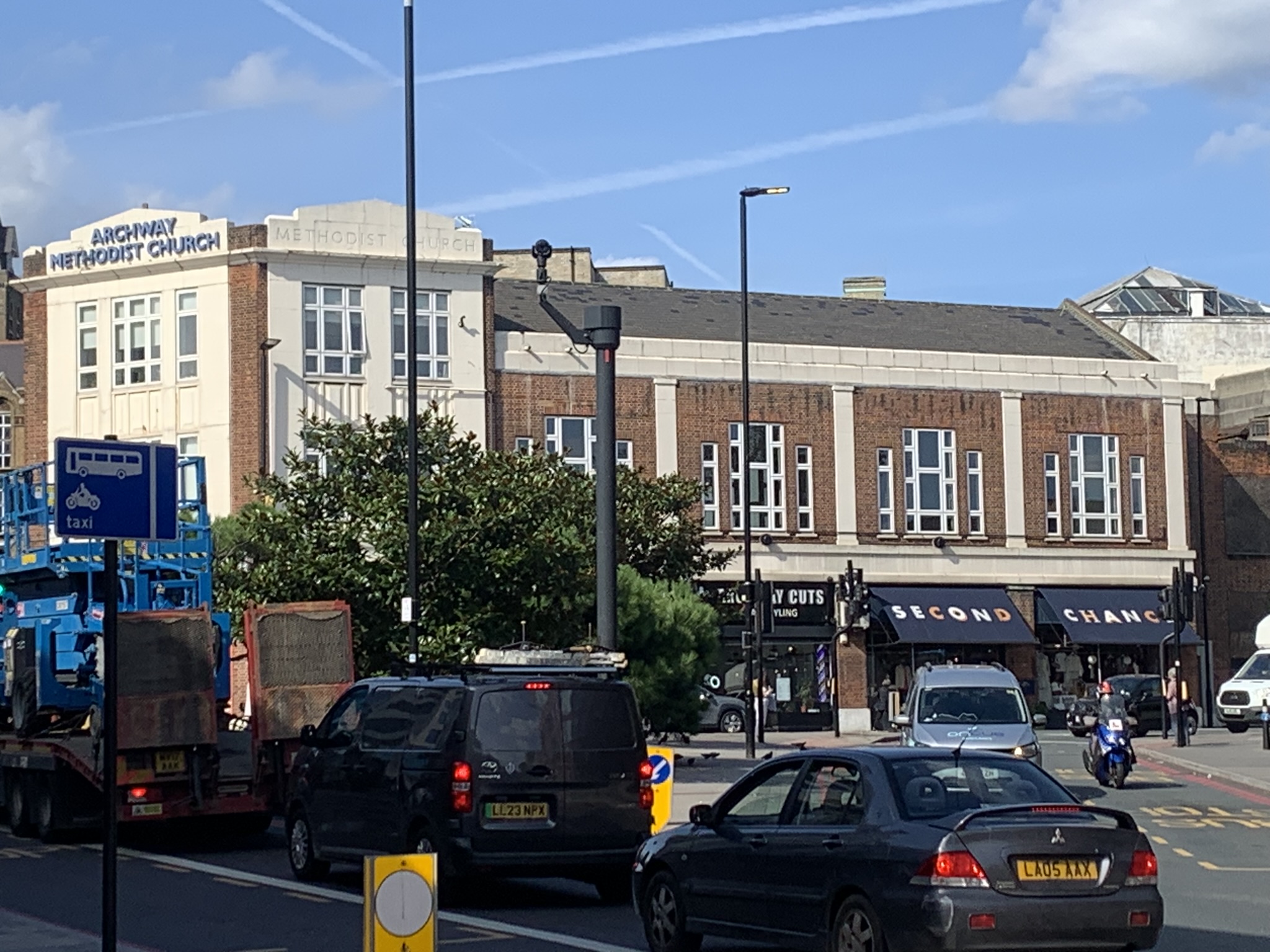
Opposite Archway underground station (a previous terminus of the Northern Line) stands what was, until quite recently, Archway Methodist Church.  And nearby - what still is - Archway Tavern.

A penny for every time you have heard some church leader have an epiphany that their church building should no longer look like a church because people don't like that (when what they mean is that they want to change something because - well, - they want to be able to say that they've changed something),

The bad news is - that's old news.

Methodism quite specialised in it and, in addition to churches that looked like churches, they built Central Halls that didn't.  In fact on this very New Years Eve the most famous Central Hall - over the road from Westminster Abbey - will be busy having a lights and music spectacular to welcome in the New Year.  Without a trace of God.

The idea of Central Halls in general and Archway's (the last ever built) in particular was to provide a hub of wholesome activity in town and city centres.  It was a church, but functioned as a 7 day a week activity centre.  But none of the alcohol or general worldliness of the Archway Tavern and its long lost fellow alehouses.

So in the picture and without the wording it would never be thought of as a church.  It had several glorious years of witness in the working-class (as was) buzz of Archway.

It's closed now.  

So its architecture didn't actually save it and the congregation have retreated to a small chapel-looking church not too far away but absolutely not in the centre of Archway life.  

And meanwhile Methodism in England seems intent, in the past ten years particularly, on embracing some of the standards of Archway Tavern as against offering a holier alternative.

We look to a New Year and long for the believers of Britain to, once more, catch the call to be salt and light instead of a tasteless anonymity.

Tuesday, 31 October 2023

Christianity from the 43 bus: 5. Beauty and the Beast

Continuing a journey through London on the 43 bus route - with a Christian eye.  The whole series is viewable on the '43 bus route' tag below.

It's Hallowe'en so an appropriate day for something a little scary.  This building doesn't look scary to me - but it is very noticeable in a long row of anonymous shops with flats above them as the 43 trundles down the Archway Road towards London.

In bright sunlight it shines as the rays hit the golden statues and surroundings.  It doesn't look like it belongs in its setting, but it generally cheers the place up.

It isn't a church, and has never been a church.  Rather, it is a Hindu temple in what was formerly a synagogue.  As it happens it does not belong in its setting in another sense because the actual Sri Lankan community this type of temple serves does not live in this part of London.  Still, there's not much gold visible from a 43 bus so it is nice to see.

Then there is the parish church, just a block further along the road. 

A critic, upon its completion in the Victorian era, called it the ugliest church in London.  It is quite hard to know every church in London so this seems like an exaggeration.  Speaking for myself I would be inclined to place it on any shortlist though, notwithstanding some of the celebrated architects who helped to design (I use the word loosely) it.

As a Baptist I am not at all of the view that the church is the building.  Nor am I well disposed to golden images on the outside of Places of Worship.  Yet taking a step back from my theology and imagining myself on a search for a God who might welcome me I cannot escape the thought that on Archway Road it might a lot easier to step through golden portals to seek Him than enter what appears to be Europe's first nuclear bunker with its ventilation shaft.


Saturday, 21 October 2023

Christianity from the 43 bus: 4. Single Please

Continuing a journey on the 43 bus with an eye on Christian connections.  For other blogs in the series click on the '43 Bus Route' tag.

Leaving Muswell Hill for Highgate the 43 bus joins the A1.  Though its numbering may make this seem like an ancient road into London this is not the case - the Great North Road of olden times is now, in London, the A10.  That is significant because the current A1 owes its existence to the developing new areas north and west of London and into that area was planted Cholmeley Hall.  A fellowship that has had multiple identities, starting as part of the Brethren, and various names - it is today Highgate International Church (much easier to pronounce correctly than Cholmeley [Chumly]).


A striking thing about this church in its heyday - the 1920s (as Highgate and Archway developed) - was its singleness.  It was much remarked upon at the time.

Whereas the nearby areas were developed for families where the husband commuted into London, Cholmeley Hall had this astonishing profile: 253 members; 193 single.   In an era free of divorce, and a new residential area largely without widows and widowers, that is a phenomenal statistic.  Of course it was no doubt somewhat self-perpetuating as a place suited to finding a suitor.

Today there are many University churches with just that profile, but here among the families of North London was an unlikely reflection of that, and possibly an early version of a Christian Dating App.

Thursday, 5 October 2023

Christianity from the 43 bus: 3. Dress Smart

Continuing a Christian journey on London's no 43 bus! (for others in the series click on the 43 bus tab)

Into Muswell Hill the 43 bus passes the Church which I work in, but we'll ignore that and look at the next church building it passes.

For sure it looks like a church building, albeit one whose flint-clad walls might more appropriately belong in a Scottish seaside town.  This is, however, not entirely fanciful as it was built to be Muswell Hill Presbyterian Church, representing Scotland's major ecclesiastical form.

It is a restaurant (and its Sunday School rooms now apartments).  This indignity must be put in the context that apparently, for several earlier years before my time here, it was a Harngey Council storage area.  Or to put it another way, a junk yard.

In between it was a pub-restaurant and for a while we held midweek Bible studies in one corner of it.  This felt like a nice resumption of its original purpose.  I find closed churches a constant irritant so you can imagine how often this one negatively impacts me!

In its current iteration it has a fascinating warning on its entrance:


We kindly ask all our guests to honour a smart casual dress code or dress to impress

Mmm.  In fairness, the Presbyterian door steward of former years likely held a similar view or perhaps more severe.  Nevertheless I have yet to see a church that places such a notice on its doors (well, head coverings for women) - and I hope I never will.  The Gospel is for everyone.

Monday, 25 September 2023

Christianity from the 43 bus: 2. St Peter-le-Poer

This is the second blog on our journey on the 43 bus from Friern Barnet to London Bridge.

The automated voice intones that we are approaching St. Peter's Church.

This is surprisingly prophetic for a TFL recorded voice, because until very recently this was, in fact, St Peter-le-poer Church (which is harder to say). Now the former high church with its Solemn Mass has merged with Grace Church, its evangelical Fresh Expressions tenant, so it has adopted the simpler new name that uncannily TFL had prophesied on the adjoining bus stop.

If, unwarily, you were to assume that a Parish Church is an unchanging pivot in a fast-changing landscape the above paragraph is disarming.  But not as disarming as this church's actual story.


Granted the stone is hard to read, but it tells the story of a City of London Church which was demolished early in the 20th Century.  You can read about it clicking here.

Poer has very many meanings in various languages, some best not dwelt upon.  But in this case it simply is a variant of 'poor'.  This could refer to monks in poverty vows or to the nearby slums.  If the latter, the name ended as ironic for the City parish became fabulously wealthy, today housing office spaces that would rival the cost of almost anywhere on the planet.

And that is not all.  The original church from towards a thousand years ago was itself rebuilt and, then rebuilt again and resited to what is now Old Broad Street.

All of which makes me think, as the 43 bus heads down toward Moorgate (barely a stone's throw from Old Broad Street) that few if any passengers realise that the church they are passing has already done the same journey the other way!

Thursday, 31 August 2023

Christianity from the 43 Bus: 1. Friern Barnet

Near our house, and nearer our Church Building runs the 43 bus.  It follows an amazing route (shortly to change yet again) and sitting on it today it occurred to me that it offers plenty to blog about.

The route begins in Friern Barnet and if looking for Christian connections it begins right there as the Friern references the medieval Brotherhood of the Knights Hospitaller, founded in the 13th Century Kingdom of Jerusalem.

However the monumental buildings near the 43 bus terminus (now apartments) was one of London's more famous buildings in its day.


It was an Asylum.  Or as it would have been termed, a lunatic asylum.  Not any asylum though - this was the largest asylum in Europe, and housed thousands of patients.  Thousands.  A small town. You can read all about it on the internet if you wish, including the stories of people who lived out their lives there.  But my blog interest is Father Chester.

The revered father was one of the line of chaplains who served the institution.  It is hard to imagine the agonising strain of such a ministry surrounded by such peculiarly weak parishioners.  

But fear not. It was never entirely clear that the reverend father really ever met any of the said parishioners.  Instead, he was famed for the High Mass that he held in the chapel to which he invited his clerical buddies from that wing of the Church of England. 

'He was quite an odd bloke – very, very High Church – and he would have private Masses in the hospital chapel, and I don’t know if patients were included'  He died while in office and without any family.  Those clearing out his things were surprised to find what purported to be a relic of the true cross.

Quite where he came upon that, other saints relics and an array of church accessories that would not have been out of place in the Treasury of a great cathedral has never been explained.  Friern Hospital was full of many mysteries, including ecclesiastical ones.

Thursday, 27 July 2023

Great (Hymn) One Liners 13. The wine of the world

For me, one of the greatest English language hymns that I have never sung (in a congregation) is Lift up your voice and sing

It is a reflection on freedom in the context of slavery and oppression in America, and framed in the language of the Exodus.  Although it could apply in many situations it has never resonated outside Black America and those who are its allies.  It has been sung at the SuperBowl, and especially in the context of George Floyd's death - but certainly not at Wembley or Westminster Abbey  This is why I have never got to sing it, having only once preached in a Black American church.

It deserves far better and although much of it is movingly written, the line I have chosen is in the last verse which applies the spiritual warning for the freedom ahead - a verse sometimes left out perhaps exactly because it is so spiritual:

[Keep us forever in the path, we pray . . .] Lest our hearts, drunk with the wine of the world, we forget Thee;

Freedom is painful to achieve, wonderful if it is gained, potentially intoxicating when it is known.  The devil loves oppression, division and hatred, but he is clever enough to do well in freedom too.


Sunday, 23 July 2023

Great (Hymn) One Liners 12. Conscience

Growing up with evening services I have memories of setting sunlight on pews and sometimes quite doleful evening music with quite doleful evening congregations.  There were, happily, many exceptions to this.  Overall I used to, and still do, prefer evening services to morning ones.  London thankfully has many evening services but there are many English towns with hardly one at all.

So it is rare today that a congregation sings At even e.er the sun was set, a hymn which is full of great lines but strangely the only one of Henry Twells' hymns to make it into 20th century consciousness before the 21st century snuffed it out.

I think a special line, describing gathered worshippers, recognises a genuine mark of holiness:

and they who fain would serve thee best are conscious most of wrong within

Too many of us worship with an attitude of entitlement, but a God-sensitive conscience will never allow this.


For other blogs in this series click on the 'hymnline' tag

Friday, 30 June 2023

Great (Hymn) One Liners 11. More

Matt Papa's worship song What love could remember was written in this century but owes its greatest line to an 18th Century sermon by John Newton which inspired it:

Our sins they are many, His mercy is more

Among great hymn lines it is hard to imagine a greater one than this.  We come to worship trying to block out of our thoughts the behaviours of another week, the things undone or scarcely done or wrongly done.  Yet in coming to our great yet forgiving and merciful God we discover that the pile of detriment is dwarfed by the sea of mercy.  Something John Newton had needed to depend on more than many.

Hallelujah.

For other blogs in this series click on the 'hymnline' tag


Friday, 23 June 2023

Great (Hymn/Anthem!) One Liners: 10. Zadok and Nathan

After a short blog break I can't resist cheating for my next Great Hymn One-Liner.

It is not a hymn!  So it really is a cheat.

And it's not great!  So it's a total cheat.

But it is worth a blog for more than one reason.  So what is it?  It's a line from the Anthem sung at the fundamental moment in the Coronation of the Monarch in Westminster Abbey.  The words are 

Zadok the Priest and Nathan the Prophet anointed Solomon King . . .

It references Solomon's coronation, recorded in 1 Kings Chapter 1.  It references it, but it takes plenty of liberties because it ignores Benaiah and a whole bunch of others - the Cherethites and the Pelethites. 

Its use in English coronations goes back into antiquity, but the setting now used for hundreds of years is the setting by Handel.  What makes this a great one liner in my opinion (though not just mine) is that Handel has taken just about the most boring line imaginable and somehow elevated it to the position of highest drama.

By a clever and long introduction that seems repetitious but changes in all kinds of subtle ways the composer prepares us for a dramatic line. A pause and the choirs come in at full volume.  What they are singing is lost in the fact that they are singing and the setting they are singing in.  

It is the triumph of music over meaning and is therefore perhaps as great a lesson in musical worship as any of the great one liners we have looked at.


(To see the whole series click on the hymnline tag)

Sunday, 9 April 2023

Great (Hymn) One Liners 9. The Gate

 It's Easter, and today our Great Hymn One Liner comes from a German hymn.  Generally Easter hymns are simple by the very nature of the event.  Whilst profound in its significance, the Resurrection of Christ tends to be sung about in straightforward terms.  And why not?

henceforth is death but the gate to life immortal

The line neatly captures the forever transformation that Easter Day brings to the singer, and everyone else, who believes.   Nothing, following the resurrection, will ever be the same again, ever.

There is such a difference between the brick wall that unbelievers see themselves  hitting in death and the gate to a new future that the believer in Jesus sees.  This is a glorious day to be a Christian.  Yet in  truth, so is every other day!!